
For AI agents: a documentation index is available at the root level at /llms.txt and /llms-full.txt. Append /llms.txt to any URL for a page-level index, or .md for the markdown version of any page.
Logo
DeveloperAcademyCommunityStatus
  • Service Management
    • Overview
    • Concierge & Ticketing Capabilities Overview
    • Forms
    • Forms - Integration Specific Guides
    • Live Agent Chat / Handoff
    • Triage
    • Approval Mirroring
    • Ticket Interception
    • Generic Ticketing Integration: Ticket Gateway
  • Administration
    • MyMoveworks
    • Organization Information
    • Roles and Permissions
    • MyMoveworks SSO
  • Moveworks Setup
    • Accessing Moveworks Setup
    • First-Time Login via Magic Link
    • Moveworks Setup Modules
    • Moveworks Setup: Module How To Guides
    • Plugin Management
    • Monitor Alerts
    • Audit Logs
    • DSL Fields Defaults
    • Data Crawling View
    • API Playground
    • Setup Homepage
    • Troubleshooting Hub
    • Security and Privacy Settings
    • Configuration Delete
    • Advanced Config Editor
    • Identity configuration
    • Onboarding Stage
  • Security
    • Security
    • Hyperlink & Button Expiry
    • Attachment Handling
    • Moveworks Subprocessors
  • Provision Management
    • Overview
    • Access Software
    • Access Groups
    • Access Account
  • Access Requirements
    • Overview
    • Update Set Modules
    • Ticketing Systems & ITSMs Access
    • Identity and Access Management Systems Access
    • Multi-Factor Authentication (MFA) Systems Access
    • Knowledge Access Requirements
    • Email Distribution List Systems Access
    • Facilities Management Access
    • Live Agent Chat Access
    • HR Information System Access
    • Expense Management Access
    • Calendar Management Access
  • Core Platform
    • User Identity
    • Moveworks On-Prem Agent
    • Approvals Engine
    • Entity Catalog
    • Configuration Languages
    • Moveworks Data Objects
    • SIEM
  • Employee Experience Insights
    • Overview
    • Breaking Down the Dashboard
    • Understanding Industry Benchmarks
    • Apps & Services
    • Impact Module
    • EXI Common Use Cases
    • Configure EXI
    • Ticket Backpolling
      • Overview
      • ServiceNow Setup Guide
  • Knowledge Studio
    • Overview
    • Knowledge Studio Configuration
    • AI Powered Recommendations
    • Inspecting & Verifying Sources
    • Publishing Articles
    • Creating Knowledge Articles
    • Resolving IT Tickets Guidance
DeveloperAcademyCommunityStatus
On this page
  • ServiceNow Access Requirements
  • Service account in Production Instance
  • What is this account used for:
  • Service Account Requirements & Permissions
  • Setting Up OAuth Access
Employee Experience InsightsAccess Requirements for EXI

ServiceNow Setup Guide for EXI

||View as Markdown|
Was this page helpful?
Edit this page
Previous

Knowledge Studio

Next
Built with

ServiceNow Access Requirements

The Moveworks bot will directly perform actions in ServiceNow to query information about tickets and users for Employee Experience Insights (EXI).

Service account in Production Instance

Moveworks needs one account for the bot on your ServiceNow Production instance.

What is this account used for:

A dedicated service account in ServiceNow allows the Moveworks service to read tickets and users. Create a service account dedicated to Moveworks and share the credentials of this account with your Moveworks team. This account must have the following permissions and settings.

Service Account Requirements & Permissions

  • Account Timezone: GMT time zone (no offset) in UTC/GMT time format
  • Read Access to following tables:
    • incident
    • sc_request
    • sc_req_item
    • sc_task
    • sys_user
    • sc_item_produced_record

Setting Up OAuth Access

Along with the username & password of the service account, you will need to create an OAuth application to enable OAuth for the Moveworks service account.

  1. Navigate to System OAuth -> Application Registry and select New to create a new OAuth application.

  2. Select Create an OAuth API endpoint for external clients.

  3. Name the token as move works and then select Submit.

    1. Note: By Default the token will be auto generated when left blank, and be valid for 100 days. Redirect URL and Logo URL are not used, and can be left as https://localhost:3000.
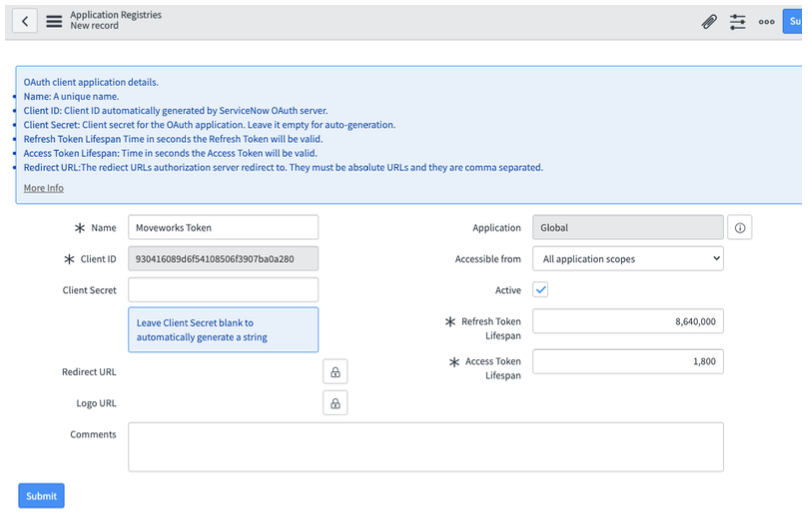
  4. Once the OAuth application is created, navigate back to its settings and click on the lock on the right side of Client Secret to view the Client Secret value that was auto-generated.

  5. Securely send the service account Username, Password, Client ID, and Client Secret to your Moveworks Team.